
Most people arrive at bonsai the same way. You see one in a shop window, on a colleague's desk, in a photo, and you want one. Then you start reading, and within ten minutes you've hit a wall of conflicting advice about soil particles, wiring gauges and whether the thing will die if you look at it wrong.
Ignore all of that for now. The first decision is simpler: indoor or outdoor. Get that right and most of the rest falls into place.
Why the distinction matters
Bonsai aren't a special kind of plant. They're ordinary trees kept small through pruning and root work, which means they want what any tree wants. For most species that includes a proper winter: a cold, dormant spell where growth stops and the tree rests.
A centrally heated living room can't provide that. Trees that need dormancy and don't get it will limp along for a season or two, then give up. This is the single most common reason a first bonsai dies, and it usually happens months after the mistake was made, which makes it hard to spot.
The trees sold as "indoor bonsai" come from tropical and subtropical regions where winter never really arrives. Those are the ones that will tolerate your house.
Good indoor choices
Banyan Fig (Ficus)
If you take one recommendation from this page, take this one. Ficus will forgive a missed watering, an imperfect spot and most of the mistakes a beginner makes.
It does sulk when moved. Expect a few dropped leaves after any change of position, and don't panic about it. Given decent light and a bit of humidity it thickens quickly and starts throwing out aerial roots, which is what gives mature ficus that heavy, tropical, slightly prehistoric look.
Chinese Elm (Ulmus parvifolia)
Worth being honest about this one. Chinese Elm is sold everywhere as an indoor tree and it will live indoors, but it's genuinely happier outside in a sheltered spot for most of the British year. It's tougher than its reputation suggests.
Either way, it's an excellent learning tree. Small leaves that stay in proportion, attractive bark as it ages, and it backbuds readily, meaning new shoots appear where you've pruned. You can actually see the effect of your decisions within a season rather than waiting three years.
Good outdoor choices
Japanese Maple (Acer palmatum)
The obvious choice, and deservedly so. Nothing else quite matches an acer in October.
One caveat that rarely makes it into the sales copy: they scorch. Fine leaves, hot afternoon sun and drying wind are a bad combination, and scorched foliage stays scorched until it drops. Morning light and some shelter from the wind will do far more for your maple than anything else you can offer it.
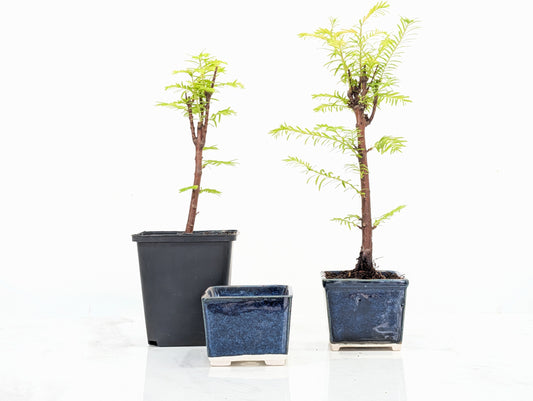
Dawn Redwood (Metasequoia)
Fast. Properly fast. You'll see meaningful trunk thickening within a couple of seasons, which is unusual and very satisfying early on.
They are thirsty, though. A dawn redwood will not forgive a pot that dries out in July the way a pine might. Because they grow quickly and cost little, they're the standard choice for forest plantings, where you want several trees of varying heights and can afford to experiment.
Beech and Oak
Native, slow, and worth the wait. English Oak and Beech both develop the sort of rugged trunk that makes people stop and look, but you're working over a decade rather than a couple of seasons.
Beech holds onto its dead copper leaves through winter, a habit called marcescence, which is either a lovely seasonal feature or a slight nuisance depending on your taste.
Spruce (Picea) and Japanese Holly (Ilex crenata)
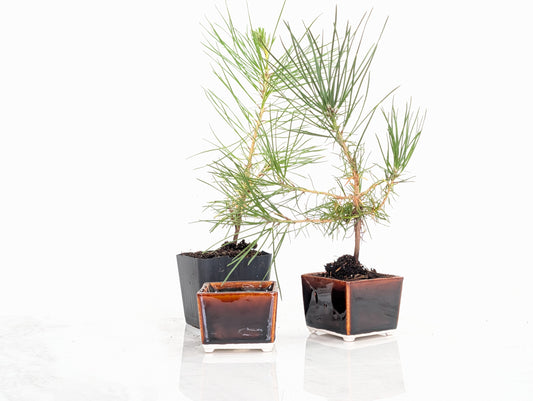
Spruce handles British winters without complaint and suits the classic mountain conifer styles: dense needles, tight pads, upright and windswept forms.
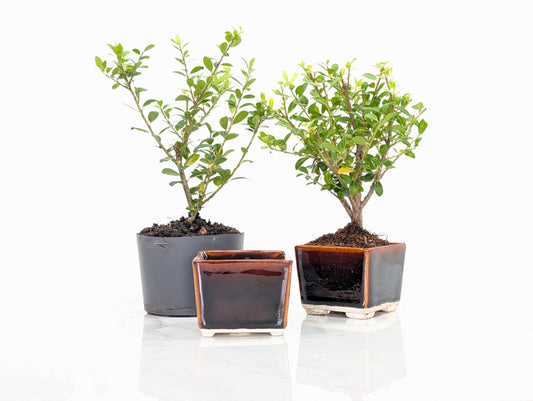
Japanese Holly is an evergreen broadleaf with tiny dark leaves, close enough to Box that it's regularly mistaken for it. It clips into neat foliage pads and holds detail well, which makes it good for fussier, more intricate work.
Cotoneaster
Underrated, and quietly the most rewarding of the lot. Tiny dark leaves that stay in scale, white flowers in spring that the bees find within about a day, and red berries that carry it through autumn. Tough, inexpensive, and difficult to kill. If you want something outdoors that gives you a reason to look at it in every month of the year, this is it.
Starting from scratch: our Build Your Own bundles
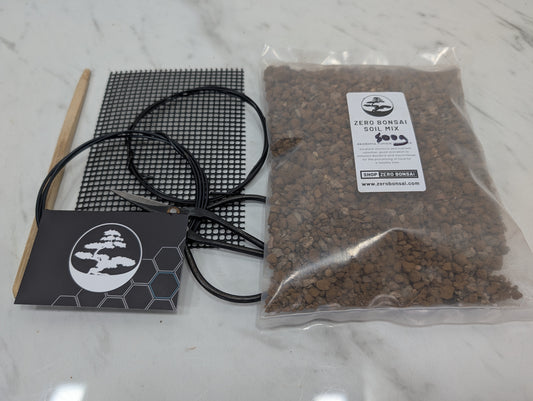
The bit that puts most people off isn't the tree. It's realising you also need a pot, the right soil, drainage mesh, wire, and something to work the soil in with, all from different places, in quantities far larger than you need.
Our starter bundles solve that. Each one contains:
- A healthy young tree, chosen for how forgiving it is
- A handcrafted pot, sized properly for the tree
- Specialist bonsai soil, mixed for drainage and aeration
- Drainage mesh and training wire
- A bamboo chopstick, which is still the best tool anyone has found for working soil around fine roots without tearing them
Indoor and subtropical: Mandarin, Chinese Elm
Outdoor: Dawn Redwood, Spruce, Japanese Holly, Cotoneaster, and a selection of Japanese Maples
There's a real difference between buying a finished bonsai and making one. Potting the tree yourself, deciding where the roots sit, putting the first wire on a branch. That's the point at which it stops being an ornament and starts being something you're actually doing.
Have a look through the full range of starter bundles and pick the one that suits where you'll actually keep it. That last part matters more than which species you fancy.